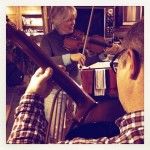
A great observation of the Alexander Technique at the Montana workshop:

Last spring when I was in Tucson I went to Gianna’s (my granddaughter) violin lesson. (she’s just beginning). She was “sawing” away at the song. Her teacher said “Operate the bow from your whole arm, not just from your elbow.” What a difference in sound. Sound went from flat to full. I took violin as a child and must have learned that because when playing her violin it was natural for me to bow with my whole arm.

I noticed Scott, also, when helping her with her lesson bowed from the elbow. When I pointed that out he immediately picked up on doing it differently – it was harder for Gianna to “get” the difference.

I would suppose a violinist who used the bow from the elbow would eventually develop an injury. In other words “tennis elbow”??

When we ask our body to perform an action w/o the full repertoire of joints and muscles and tendons intended to perform that action then we create wear and tear and eventually injury, I would guess. Very interesting.

Thank you for the class. It was enlightening. It’s very comforting being around you.

Cheryl C
Workshop participant in Montana last weekend.
20131104-185302.jpg

Can Alexander Yoga relieve the tensions of playing a musical instrument? Pain disappears, sound resounds!

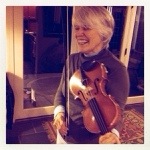
As a new musician of the violin/fiddle, I am so amazed when I watch musicians play…the passion, emotion, skill and poise is now so much more obvious to me.  I had no idea it was such an incredible way to be with yourself and with others.  The vibration I am feeling in my whole body helps me sense the emotion that comes from the music whether it is a classical piece or a fiddle tune.  I am happy to be alive and aware of spaces inside and outside of my body.

The other surprise to me is how much subtle tension in the head, neck and jaw affects the sound of the music…it is so revealing that the ever so small adjustments make incredible changes in how the music flows out to the ear (mine and the spaces around me). I teach Alexander Yoga and have found many of the poses we do inform my body about how balanced or imbalanced I am. I can take these relationships of balance to how I am holding my fiddle.  At first I learn about myself and my habits of tension when I am not playing my instrument; then I can recognize these same tensions when I pickup my fiddle (where I have a lot of muscle memory tension).  We start with being aware of our balance and poise in our everyday moving patterns and the yoga asanas.  This new information continues to unravel and the sound of the music becomes more and more enhanced.

If you have pain from playing a musical instrument, explore the skill of learning the Alexander Technique through Alexander Yoga;  the results are long term and sustainable because you are learning to find joy, ease and fun by releasing unneeded tension.  You will enjoy playing so much more and your audience will notice the change in the sound of the music.FiddlePlayingKaren2012

Does awareness alleviate pain?

When I read this in eastern spiritual teachings: Liberation from suffering comes from being aware;  I like to think about how this relates to the suffering in our bodies through pain, injury, emotional trauma, and disease.  Awareness helps us identify the suffering whether it be pain, emotional distress, trauma, and disease; and how does it “liberate” us from the suffering?

I have experienced through my work as an Alexander Technique practitioner that when we can consciously identify our tensions, imbalances, uncoordinated posture, AND relate them to how our bodies move; there is a “liberation” of our discomfort. Our habits are patterns that we ignore because we do them so automatically; and I feel that “awareness” is the first step to identifying these patterns.  We then can choose to cease doing what we have always done, and find a more easeful and balanced natural way to do the same task. Whether it is walking, lifting, playing tennis, sitting at the desk, texting, playing a musical instrument, public speaking and the list goes on. We find that when we use our whole body to move, all our joints move with elasticity and flexibility; not overworking any one joint or muscle.

What a great way to educate your SELF so that there is long term ease. YOU learn a very profound relationship to your own body and your movement that you can change!